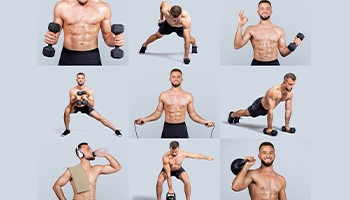
Are you a fitness enthusiast who has established a solid fitness foundation but is bored of the same mundane routine and needs something more challenging to level up? Then advanced training is your calling!
If you want to set the bar higher for yourself and achieve more specific fitness goals such as muscle building, or improve your athletic performance then we have compiled a guide of some of the most challenging advanced training techniques that you can try conquering.
15 Advanced Training Techniques
1. Drop sets
Drop sets are a very unique technique that pushes your limits by performing an exercise until you reach failure or near failure, then you proceed to quickly reduce the weights and repeat with lighter weights
This method not only pushes your muscles to fatigue by working them to their limits, but it also increases your endurance, workout intensity and metabolic stress.


There was a study conducted with 142 (28 women and 114 men) participants to measure the effects of drop sets on skeletal muscle hypertrophy (bulking) and it was found that some drop sets techniques took one-third of the time to bulk compared to traditional training techniques. (1)
How to perform a drop set?
- Do an exercise with 10-20 reps
- Reduce the load of the exercise by 10-30%
- Minimal resting and repeating the process
2. Super sets
Supersets are an impressive training technique wherein you perform two different exercises continuously with little to no rest in between. This technique allows you to complete more volume in a shorter period.
A research was performed with 14 male participants who completed a familiarisation session and three resistance training protocols and included super sets. It was concluded that supersets significantly enhanced training efficiency and reduced training time. (2)
How to perform supersets?
- Begin with a shoulder press, then immediately move on to lateral raises with minimal rest in between.
- Alternate between bench presses and dumbbell flies again resting very briefly between the sets.
3. Cluster sets
Cluster sets are focused on increasing performance and minimising fatigue by breaking down a traditional set into smaller “clusters” with brief resting gaps in between.
A study suggests that cluster sets when compared to traditional sets showed a greater number of repetitions when using a 90% power-based threshold that can be used by coaches and athletes during power-on velocity-based training periods wherein greater training volumes are desired. (3)
How to perform cluster sets?
- Begin with sets of 3 reps
- Rest 10-20 seconds
- Repeat reps & rest cycle for 3 times
4. Negatives
Also commonly known as eccentric training, Negative reps is a technique of performing only the eccentric rather than the concentric part of a lift. The eccentric part of the lift refers to a phase where the muscles are stretched in an exercise routine.
A study shows that negative reps enhance maximal muscle strength, and muscle hypertrophy, and improve athletic performance and muscular power. (4)
How to perform negative reps?
In a bicep curl, the concentric part is when you lift the weight and the eccentric/negative part is when you put the weights down before repeating the set, here’s where you need to slow down when you are pushing the weight down it may seem easier when done in swift motions but slowing this part down will help you achieve the benefits by stretching the muscles out.
5. Partial reps
Partial reps means doing a rep that is between the zone of the middle and end points of a full-range motion.
For e.g When you are doing a bicep curl, lifting the curl in a full range of motion starting from the bottom contracting the muscle while it’s fully lengthened and then curling up as far as you can contracting the muscle as it shortens. These two from bottom to top become initial and final motions. While the partial rep requires you to stop midway before fully contracting the muscle in its fully stretched position and going back up.
A 2023 review concluded that training in partial reps promotes greater hypertrophy in biceps muscle in untrained women. (5)

6. Pyramid training
Pyramid training techniques is a type of program that involves increasing and decreasing weights, reps and sets in an exercise bout to achieve a specific goal.
Three types of Pyramid training techniques:
- Ascending pyramid
- Descending pyramid
- Triangle PyramidHow to perform a pyramid training workout?
- Begin with 3-4 sets of lightweight
- Proceed with 3 sets of 8 reps with increasing weight of 8-10-12
- Then decrease with 3 sets of 12 reps with weights of 12-10-8
- End with 3 sets of 10 reps of lightweight
7. Forced reps
A common technique for strength training and bodybuilding forced reps involves the continuous performance of an exercise with the assistance of a training partner or using self-imposed momentum (swinging your body to lift a barbell bicep curl) until you reach a point of muscle failure.
How to perform a forced rep?
- Choose a weight you can do 5 reps with comfortably and do it for 10-15 times with a spotter
- Have your spotter/trainer help you with lifting the portion from the bottom up and control it down
- Do it until you’ve reached your limit
8. Bench press
Bench press is one the most common exercise techniques that involves weightlifting targeting your chest, triceps and shoulders.
How to perform bench presses?
- Lie flat on a bench with your feet flat on the floor and back against the bench
- Hold the barbell with an overhand grip and keep your hands slightly wider than shoulder-width apart
- Slowly lower the barbell closer to your chest and keep your elbows close to your body
- Push the barbell upwards extending your arms fully
- Hold in the position for a while before lowering the barbell back to the same position
9. Bicep curl
Bicep curl aims at targeting your biceps brachii muscle that is responsible for flexing the elbow and forearm. This technique helps with building strong and toned arms.
How to perform bicep curls?
- Keep your body in a straight position with a dumbbell in each hand and palms facing forward
- Your elbows need to be close to your torso and as you exhale, curl the weights towards your shoulders
- Hold for a while on the top then lower slowly back down
- Repeat the set for as long as you can
10. Dumbbell shoulder press
This technique targets the muscles in your shoulders including the deltoids and triceps, it can be performed in various positions from standing to being seated or lying down.
How to perform the dumbbell shoulder press?
- Sit on a bench with a dumbbell in each hand at shoulder height and palms facing forward
- Press the dumbbells upwards until your arms are fully extended above your head
- Lower them back to your shoulder height
- And repeat as long as you can
11. Renegade row
Renegade rows also popularly known as dumbbell renegade row engage multiple muscle groups simultaneously and seamlessly merge the stability of a plank with the strength building of a row and challenge the upper body and core.
How to perform a renegade row?
- Begin with a plank position with a dumbbell in each hand
- Keep your core engaged while keeping your body in a straight line from head to toe
- Row one dumbbell up towards your ribcage while stabilising your body with your other arm
- Lower the dumbbell back to the ground and repeat the row on the other side
- Alternate side for the desired set of reps
12. Squat
A common yet popular training technique squats requires you to lower your hips from a standing position and then stand back up.
This technique helps build lower body strength, boosts calorie burn, prevents injuries, strengthens the core, and improves exercise performance.
13. Variable resistance training
Variable resistance training is a technique that involves using a changing level of resistance throughout the range of motion that challenges the muscles more effectively and leads to greater gains in strength and muscle.
How to perform variable resistance training?
- Begin with lighter-weight
- Focus on your form
- Start with lower reps (3-5 reps)
- Mix different types of VRT exercises
14. Complex training
Complex training is a training technique that combines resistance exercise with plyometric exercise with brief moments of rest in between. This training improves muscular power, athletic performance and strength.
15. Rest pause training
Rest pause training is a high-intensity workout method that involves breaking down a traditional set into multiple mini-sets with shorter rest periods in between. This method fatigues the muscle fibres more effectively and increases strength and muscle growth.
How to perform rest-pause training?
- Pick a weight you are comfortable working with
- Completely the initial set until you reach muscle failure
- Rest for a short period (10-20 seconds)
- Continue to lift until you reach muscle failure again
- Repeat 2-4 more times until you’ve completed the desired set of reps
Conclusion
These advanced techniques can be exciting and challenging for those who are bored with the same mundane workout routines.
Ensure that all these techniques are performed under the presence of a trained professional to avoid any injuries.
FAQs
1. What are the big five strength training?
The five bigs of Strength training are:
- Press
- Pull
- Row
- Squat
- Deadlift2. What is advanced weight training?
Advanced training method is a more complex and challenging form of work out that is designed for individuals who are seasoned fitness enthusiasts and professionals.
3. How to get big in 4 weeks?
To get big in 4 weeks focus on:
- Warms and stretching
- Split the routine into 4 day workout method
- Choose exercises that target multiple major muscles
- Do about 15-25 reps of each exercise
- Be consistent
4. What is the rost technique in bodybuilding?
The rost technique in bodybuilding is a therapy technique that is related to the management of pelvic gridle pain and coccydynia,
5. What is Arnold method?
Named after the bodybuilding legend Arnold Schwarzenegger It is a variation of traditional shoulder press that involves rotation of palms during the movement to engage different parts of the muscle shoulder.